Sunday, April 24, 2011

Cliff Palace Kivas

Cliff Palace is the largest and most popular of the cliff dwellings at Mesa Verde National Park in southwest Colorado. From April to November, Cliff Palace can be visited on $3, one hour ranger guided tours.

The guided tours begin at an overlook point. From above, many of the visible rooms are the circular kivas. The current trail guide says that Cliff Palace has 21 large circular, partially underground rooms and 2 kiva-like structures. The usual tour has 3 stops. At the overlook there is an introduction to the site and some safety precautions.

The group then descends to the left side and discusses how the alcove structures fit in with the overall way of life in the region, and the theories of why the alcove structures were built and why they were eventually abandoned. At the final stop, the group gathers around a kiva on the right side and views the interior details. During the busy summers, the tours begin every 30 minutes and the groups are forced to keep moving.

Many of the Cliff Palace kivas are toward the back of the site or are surrounded by square walls and aren’t visible to visitors walking along the front of the site.

The trail guide describes one of the kivas as being at the center of Cliff Palace at the point where walls without doorways divides the site into two parts. This kiva or the partition hasn’t been pointed out on any of the tours I have attended; perhaps it isn’t easy to see at ground level.

Most of the Mesa Verde Kivas show a similar design. There are usually six pillars, or pilasters, to support the roof material. A deflector wall directs the incoming fresh air from the ventilation shaft around the room and away from the fire pit.

About half of the kivas have a small symbolic hole in the floor called the Sipapu. Some kivas have passage ways to other rooms. The usual entrance is through the roof. None of the Cliff Palace kivas has a roof but there are three reconstructed kiva roofs at Spruce Tree House.


Some kivas have a recess on one side giving a keyhole shape. The keyhole shaped kivas at the large Chaco Canyon structures in northwest New Mexico are pointed out as examples of Mesa Verde influence. Kivas are most often interpreted as of ceremonial purpose because current day Pueblo people use them that way. The explanation I like is that they were necessary for winter survival.

We mostly visit these sites in the warm part of the year, not when there are several feet of snow on the ground and temperatures are freezing. The underground arrangement provides insulation and conserves heat. The kivas are the only structures we see with ventilation systems. The recess areas could be for storage of food and fuel during a storm. The passage ways provide a way to get out without exposure to the elements.


Thursday, January 27, 2011

Cliff Canyon Overlooks

The Cliff Canyon overlooks are south of the famous Cliff Palace in Mesa Verde National Park in southwest Colorado. During the winter season, the six mile Cliff Palace Loop at Mesa Verde is usually closed to vehicles, but can still be hiked or cross country skied. During the busy summer season, most visitors pass quickly by the Cliff Canyon view points after visiting Cliff Palace or heading to Balcony House.


 I snow shoe hiked part of the Cliff Palace Loop in late January. In 2011, the snow has been groomed for easy snow shoe walking and skiing. At the lasso part of the loop, I stayed right and visited the Cliff Palace overlook and the two Cliff Canyon overlooks. It took me about 0:45 minutes to arrive at the Cliff Palace trailhead. In winter, there are also view points of Cliff Palace from Sun Point and Sun Temple on the west side of Cliff Canyon.

The first viewpoint south of Cliff Palace is the Cliff Canyon Overlook. Across the canyon is Sun Point on the Mesa Top Tour, which is one of the best ruins view points in the region, with up to 12 ruins sites visible. To the right is a side view of part of Sunset House. Looking across the canyon, there are three small ruins sites visible. Sun Point Dwelling has only three rooms along a narrow ledge over a 100 foot drop off. To the left of Sun Point Dwelling is Site 634 with 16 rooms and 2 kivas.

Along this segment there are some views up Fewkes Canyon with some side views of Oak Tree House and the Sun Temple. The best views of the several Fewkes Canyon ruins sites are along the Mesa Top Tour.


A short distance further south is a view of the House of Many Windows. The multiple openings are actually doors. The site is thought to have 11 rooms and maybe a kiva. I turned around at the House of Many Windows overlook and returned the way I came. My total snow shoe hike was 2:30 hours for about 4 miles on a 35 F late January day. It had been 4 weeks since 2 feet of snow had fallen and there had been some melting without any additional snow.


Friday, January 14, 2011

Cliff Palace Loop in Winter

The Cliff Palace Loop is the 6 mile loop road that leads to the popular Cliff Palace and Balcony House tours during the summer season at Mesa Verde National Park in southwest Colorado. During the winter the road is closed to vehicles, but has been groomed for cross country skiing and snow shoe hiking. I think this is a new feature for the 2011 winter season.


There is room to park in the vicinity of the closed gate without blocking it. It is about 1.25 miles along the two way road section to the beginning of the loop. Staying to the right leads another 0.25 miles to the Cliff Palace Trailhead where there are overlooking views of the most famous Mesa Verde cliff dwelling site.


The first segment along the trail passes through a forest area that was burned during the forest fires in 2000 and then normal forest borders the trail. The snow shoe hiking was easy on the groomed surface. At the loop, I took the left fork and continued about 0.25 miles to the Soda Canyon Trail. It took me 0.45 minutes to arrive at the Soda Canyon Trailhead.
 

The Soda Canyon Trail is a 1.2 mile round trip to overlooks that offer the only views of Balcony House. The trail wasn’t groomed but the route was mostly easy to follow as a wide lane passing through the Juniper and Pinon Pine forest. I got a little confused at the point where the trail crosses a drainage and then turns south. The snow hiking here was harder, with most of my steps sinking in about six inches.


Balcony House doesn't get much direct sunlight in the winter but does appear to provide shelter from the several feet of snow that the area receives. The view is from a distance, but the famous ladder and some of the features can be spotted from the overlook.
 

I spent 0:55 minutes on the Soda Canyon Trail and my total hike took 2:20 hours on a 28 F degree sunny mid January day. I didn't complete the 6 mile loop, but returned the way I came for a total of about 4.2 miles. No one else was using the trail during my hike.


Saturday, December 25, 2010

Sun Temple on the Mesa Top Tour

The Mesa Top Pit House to Pueblo Tour is a ten stop self guided tour that traces the development of building styles at Mesa Verde National Park in southwest Colorado. During the busy summer, most visitors will move their vehicles between the stops.

In winter, the segment between the Square Tower House Overlook and the Sun Point Overlook is a 3 mile round trip hike on a hard surface that is cleared of snow and free from mud. One of the dozen or so ruins structures visible at Sun Point is the mysterious Sun Temple, visible on a point to the left of the famous Cliff Palace. It is another 0.5 miles of road past Sun Point to arrive at the Sun Temple.
 
Visitors enter the site from the west side and circle around to the south side. It is hard to see, but the overall structure is D shaped, has thick walls and most of the structure has a row of narrow rooms around the outside. On the south side, there is an indent in the wall with a small square opening on each side.
 
Looking in through the small openings, there are views on each side of the line of connected small rooms. There aren’t any apparent exterior doorways anywhere around the whole building.
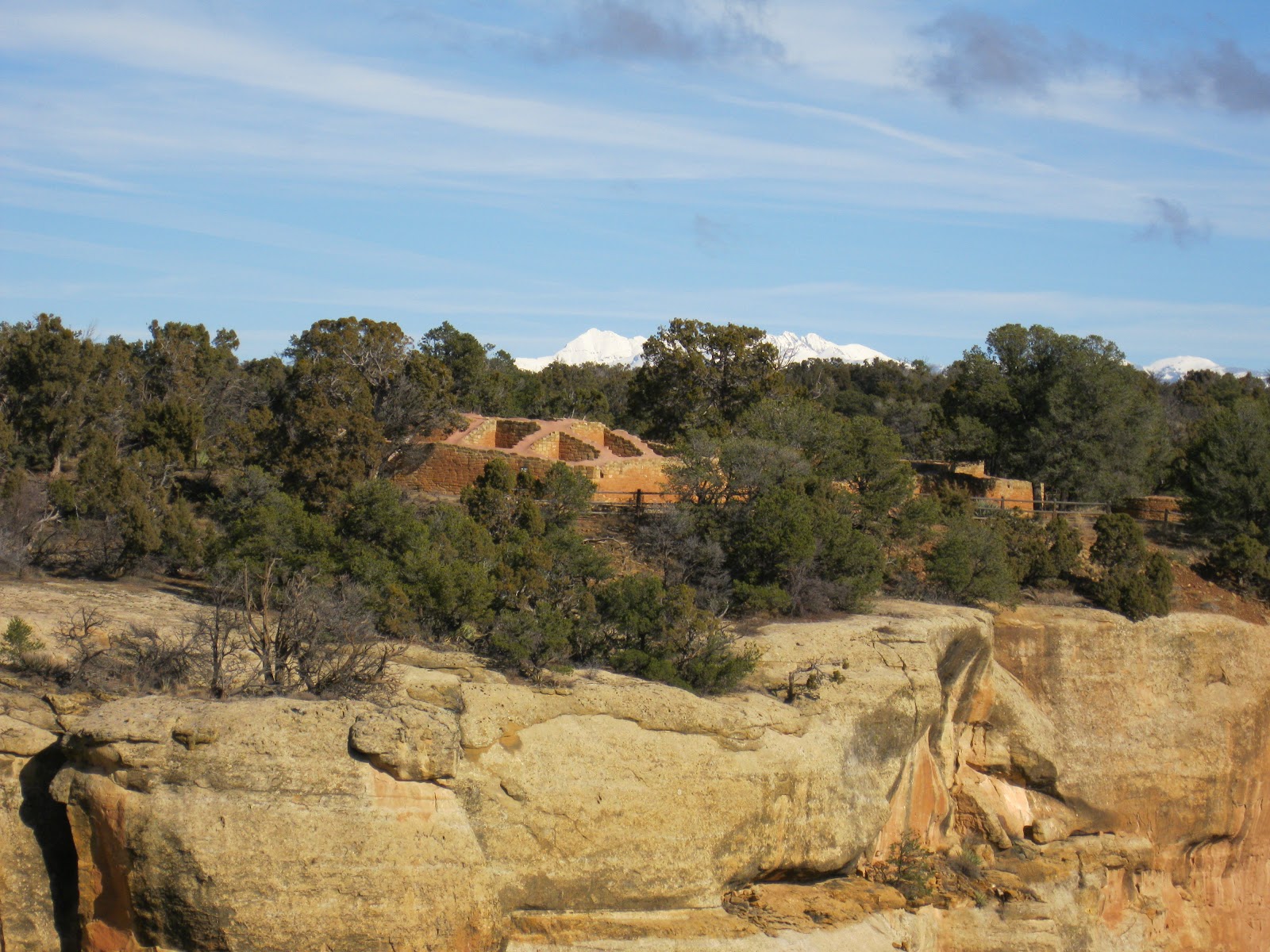
Outside the southeast corner of the Sun Temple, there is a large circular tower. Along this same side, there is a good view of the Cliff Palace across the canyon.
 
There is a rock outcrop on the north side of Sun Temple that allows a view over the walls. On the interior, there is an open area with two circular kivas. No roof materials or household goods were found here, and it appears that this structure wasn’t completed before the entire region was abandoned around 1300 AD.


Tuesday, November 30, 2010

Far View House Plaza

The Far View Trail at Mesa Verde in southwest Colorado is a short distance from the main park road and can be accessed and hiked during the winter season. Bring snowshoes in mid winter as there can be several feet of snow covering the trail. I hiked on a 30 F degree late November day with one or two inches of recent early winter snow.

Far View House and Pipe Shrine House are the two large ruins sites at the trailhead area, across a plaza from each other. Far View House was named by Dr. Jesse Walter Fewkes during the 1916 excavation for the wide views of the Four Corners area. These views today can be more readily seen from the Far View Visitor Center to the north, than from the plaza area between the large pueblo sites.

Among the 40 ground floor rooms of Far View House are 5 kivas, but only the one outside the main walls is visible. The height of the remaining walls at Far View House limits the view into the interior. One of the invisible interior kivas is particularly large and includes some features that are seen in the kivas found at Chaco Canyon in northwest New Mexico.

There are a couple of places along the front wall where the doorways line up and there is a view through a couple of rooms. The location and size of Far View House suggests that it may have served as a public building. This is also said of some of the large structures at Chaco Canyon.

Pipe Shrine House has 20 rooms and is just a short walk south of Far View House. The walls on the south side are two courses thick and thought to be the most recent work. The Pipe Shrine name comes from a dozen clay pipes found in the large kiva during the 1922 excavation.
 
The north side of the site shows the single course walls that are considered to be the older style. There are six large and varied excavated ruins sites on the one mile Far View Trail. It is easy hiking with a lot to see.